
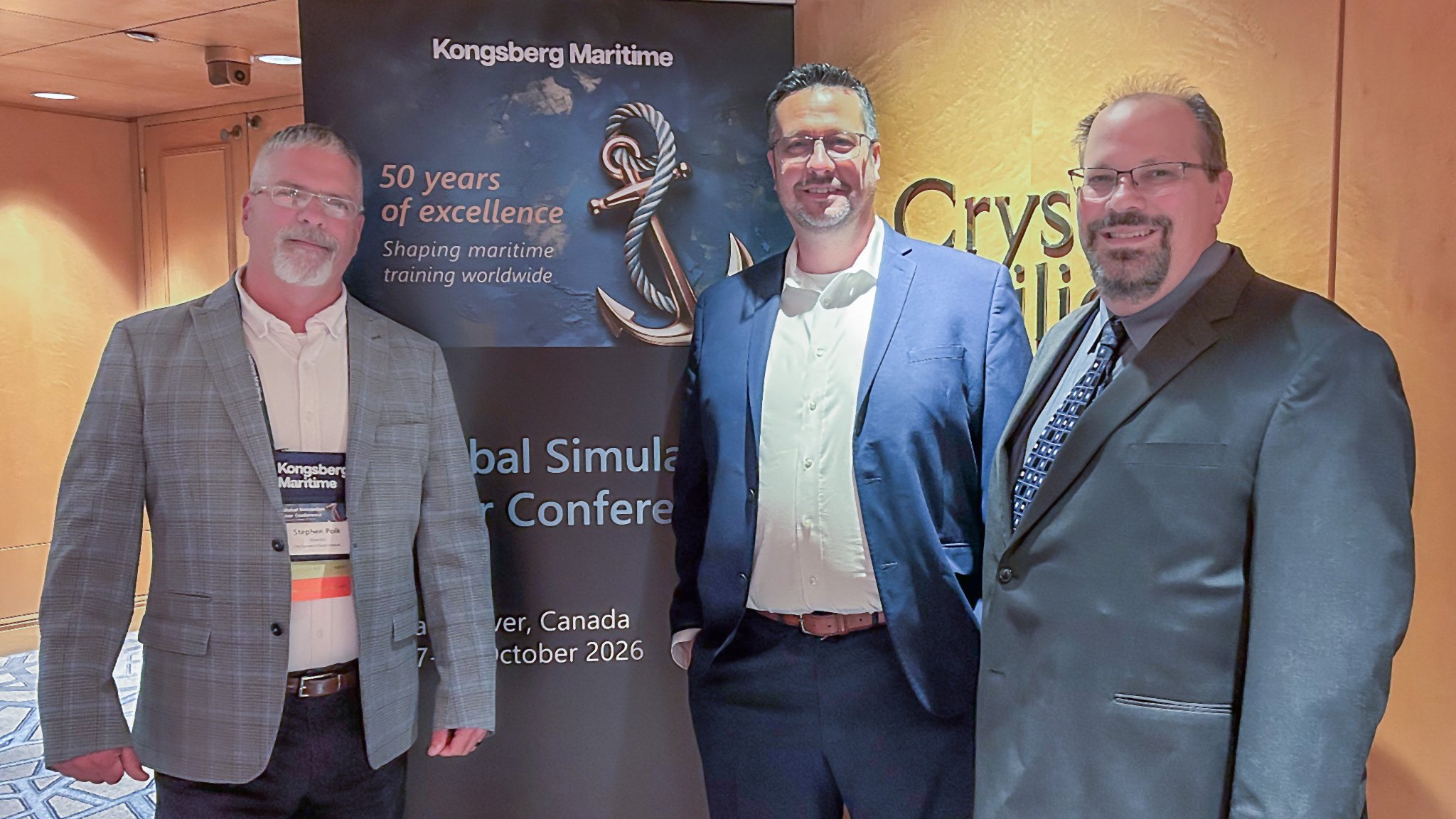
Attending the 2026 Kongsberg User Conference 2026 in Vancouver, Canada, was CME Director Capt. Stephen Polk, Deputy Director Jonathan Burson, and Simulation & Database Manager Matthew Hyner.
How accurately can a maritime simulator reproduce a vessel's behavior under real-world conditions? It's an increasingly important question for an industry that relies on simulation not only to train mariners but also to assess navigational risks, evaluate vessel performance, and plan maritime infrastructure projects.
That question was central to discussions at Kongsberg Maritime's Global Simulation User Conference, held October 27–29, 2026, in Vancouver, Canada. Representatives from The Seamen's Church Institute's Center for Maritime Education (CME) joined maritime training professionals, simulator developers, and industry experts to explore improvements in simulation technology.
A key takeaway was Kongsberg's progress in improving the accuracy and reliability of vessel modeling. Building on feedback from previous conferences, the company has invested in additional personnel and development tools to strengthen its modeling capabilities.
Of particular interest to CME was the mathematical accuracy of simulated vessel behavior, especially when accounting for tug forces and complex maneuvers. This directly supports CME's ongoing simulator validation initiative, which seeks to establish greater confidence in how accurately simulated inland vessels reproduce real-world performance. Such improvements could strengthen both professional mariner training and navigational studies used to evaluate proposed bridges, ports, and other maritime infrastructure projects.
The conference also previewed new technology, including Seaview R7, a visual engine expected in 2028, and plans to incorporate artificial intelligence into Kongsberg's instructor interface to improve training workflows.
CME representatives also met directly with Kongsberg to discuss technical challenges, model accessibility for testing and validation, and opportunities for continued collaboration. While some matters remain under consideration, the conversations were encouraging and reflected progress in addressing simulation users' needs.
For CME, the conference reinforced an important principle: the value of maritime simulation depends not simply on how realistic it looks, but on how accurately it performs. Continued improvements in modeling, technology, and validation will help CME provide maritime operators and engineers with more reliable tools to train mariners, evaluate navigational challenges, and make informed decisions before putting them into practice on America's waterways.
